This research report explores the uses of textiles as a reference in creating contemporary jewellery, particularly Isishweshwe fabric. Isishweshwe is a printed dyed cotton fabric widely used for South African traditional clothing produced by Da Gama Textiles in King Williamstown, South Africa, originates in Europe. This paper is based on a self-reflective action research that involves planning, action, observation, and reflection.
This paper consists of research based on the history of indigenisation of the Isishweshwe/blueprint in Southern Africa by Professor Juliette Leeb-du Toit. It also consists of different characteristics found in the history of Isishweshwe like the importance of the fabric in cultural significance, the Isishweshwe design names and the discovering of the fabric motifs. I found myself interested in researching more about the fabric motifs to help me create my body of work.
This paper will show the development of my findings from the important characteristics of Isishweshwe fabric, to finding geometric fabric motifs more appealing and worth working with in creating contemporary jewellery. It will also show how African people have adapted Isishweshwe fabric as part of their cultural usage.
Showing posts with label TOC. Show all posts
Showing posts with label TOC. Show all posts
Sunday, 20 October 2019

Introduction
This is my journey through researching and designing a body of work inspired by Isishweshwe fabric. Isishweshwe fabric defined as a printed dyed cotton fabric widely used for South African clothing. This research report aims to investigate how Isishweshwe and other African fabrics are used in different cultures and how Isishweshwe fabric has become a part of what African people's use for their cultural identities. I will be using the action research to develop a collection of contemporary jewellery inspired by the visual and non-visual aspects of Isishweshwe fabric. This research report consists of three chapters:
- Chapter one where I have to define the terminology in my working title and discuss contemporary jewellery with relates to my work.
- Chapter two consists of a literature review of the work of other artists and jewellers I have used as reference this research.
- Chapter three speaks about the jewellery pieces and prototypes I have created throughout this journey.
Conclusion for Chapter Three
In this chapter, I have discussed my body of work and I am very pleased with the outcome. In creating this body of work I have faced many challenging's and one of the biggest challenges has to do with being stuck on one idea and not allowing myself to think outside of the box. With my jewellery pieces that I have made I'm happy to say that I can see the growth/development from the first piece of jewellery I made to the very last. Hence I take b-tech as a foundation phase of discovering your style and interest in jewellery. I also took it as a matter of developing your techniques and finding your strongest field in manufacturing and designing jewellery. I think I have an idea of what I want to focus on in the future and that is looking more into fashion. I want to find a fashion field that excites me the most with relevant elements and aspects that I can use to create fashion jewellery.
Conclusion for Chapter Two
In this chapter, I have looked at different contemporary jewellers, artists and fashion designers. Out of all the artists I have mentioned I realised that I have taken different aspects of their work which relates to my interest. The different aspects I have looked at is the concept of how fabric is being used, the unique techniques and the methods used in their work. I have taken all these aspects into consideration and they have helped me in creating the body of work in chapter three.
Conclusion
Having had the opportunity to research and learn more about Isishweshwe fabric and its significate. I have discovered that it was and still is used for only one main purpose which is making traditional clothing wear and other fashion garments.
I have also discovered that the line between garments and jewellery is vague because according to Metcalf (1998: 2) jewellery is impossible to separate from the presence of a living person, most jewellery is made to be worn or imagined being worn. Traditionally, jewellery is made to be attached to the body or clothing (ibid). I have realised that I may have taken aspects from the garments, but the jewellery that I have made is to be worn in the body and also as a statement piece to complete the look when it is worn.
The main purpose or the driving force behind my research was so that I could be able to better understand the history of the origins of Isishweshwe and its significate and be able to use that new-found knowledge towards creating jewellery that holds a strong meaning behind it. Even though I didn't use the actual fabric but for me to be able to design and manufacture my jewellery, I had to use different aspects of the fabric, from the patterns, colours, and texture to the visual aspects I looked at in fashion. I have tried to incorporate all these aspects in my jewellery and I think I have a concept I would like to pursue in the future.
I have also discovered that the line between garments and jewellery is vague because according to Metcalf (1998: 2) jewellery is impossible to separate from the presence of a living person, most jewellery is made to be worn or imagined being worn. Traditionally, jewellery is made to be attached to the body or clothing (ibid). I have realised that I may have taken aspects from the garments, but the jewellery that I have made is to be worn in the body and also as a statement piece to complete the look when it is worn.
The main purpose or the driving force behind my research was so that I could be able to better understand the history of the origins of Isishweshwe and its significate and be able to use that new-found knowledge towards creating jewellery that holds a strong meaning behind it. Even though I didn't use the actual fabric but for me to be able to design and manufacture my jewellery, I had to use different aspects of the fabric, from the patterns, colours, and texture to the visual aspects I looked at in fashion. I have tried to incorporate all these aspects in my jewellery and I think I have a concept I would like to pursue in the future.
Introduction to Chapter Three
In this chapter, I will discuss how I have used Isishweshwe fabric as inspiration to create contemporary jewellery. I have used patterns, colours, and texture from the fabric and I will discuss how I have incorporated these aspects in my work. I have shown the work of other jewellers and fashion designers in chapter two to give an overview of the style of work that I produced in this chapter, with specific elements taken from their work. Then I will discuss the design process and the techniques I have used and also show the development through prototypes.
Conclusion for Chapter One
I have looked at different types of African fabrics and I have noticed that these fabrics are not only used for clothing, but they are used for different purposes in different cultures. I have focused mainly on Isishweshwe fabric because it is one of the fabrics that was introduced to me at a younger age as part of my traditional clothing collection.
For the past few years, I have only known Isishweshwe as a South African fabric and only used by the African people. Having the research done and learning about the origins of Isishweshwe, I have realised that African people have not only adapted certain aspects of the fabric, but we have made it our own. African people saw the need to use this fabric as part of our national identity.
For the past few years, I have only known Isishweshwe as a South African fabric and only used by the African people. Having the research done and learning about the origins of Isishweshwe, I have realised that African people have not only adapted certain aspects of the fabric, but we have made it our own. African people saw the need to use this fabric as part of our national identity.
Tuesday, 15 October 2019
Anglo Plat Prototype
 |
| Figure 1- Nkabinde, M., (2019). Silver Earrings. |
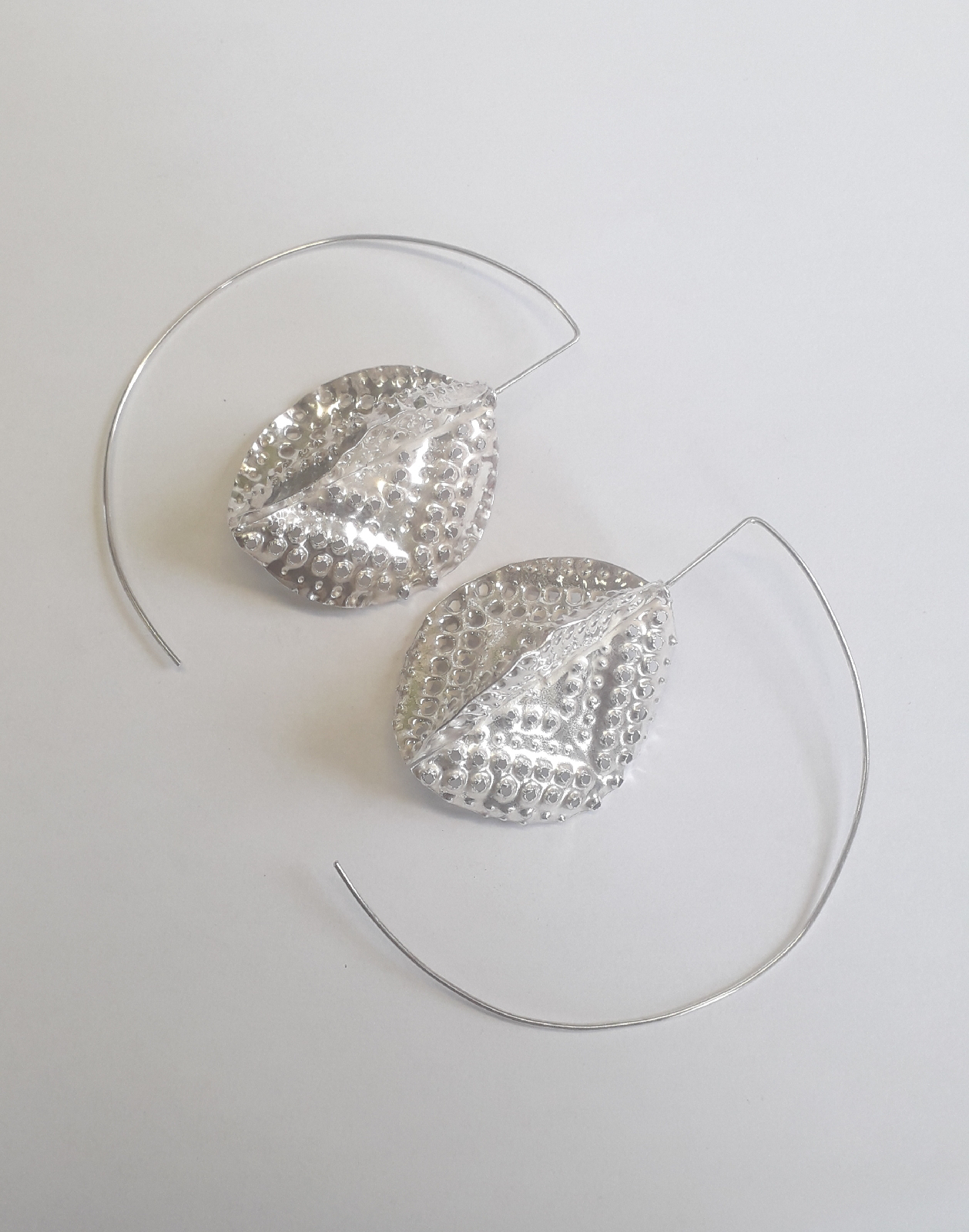
I had used the folded element from the dress worn by the bride and I also abstract few elements from the head-wrap, how it forms those curves at the edges and the whole three-dimensional form the head-wrap create. I had to test how the folding was going to work with copper first before making the prototype, and I was very happy with the results, I had to make sure I used a thin plate so I can get nice curves. This pair of earrings represent all the struggles and all the good times you get in a relationship before the commitment. I wanted to make something that withholds the good and the bad in one but with a beautiful look on the outside.
Monday, 14 October 2019
Twirling Punched Earrings
 |
| Figure 1- Nkabinde, M., (2018). Twirling Punched Earrings. Silver. |
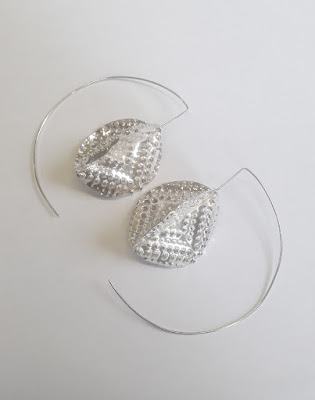
I had used the pattern template from the previous test pieces and prototypes but I decided to punch the patterns in different directions to represent the spots and the different stages you get in a relationship. The patterns punched in a very thin plate and I would allow the punch to go through the plate to allow the metal to form fluted edges. If you put the earrings together the hooks form a circular shape which symbolizes infinity. I made these earrings because I wanted to show different stages in a relationship using punching and patterns from Isishweshwe to give visual aspects of how fabric can be used in another medium.
Sunday, 13 October 2019
Introduction to Chapter One
In chapter one, I will be defining the terminologies of my working title which is Using Isishweshwe to create Contemporary Jewellery. To make sure the reader has an understanding of the idea that will be discussed throughout this report. Firstly I will discuss the history of Isishweshwe including the important characteristics, the naming, fabric motifs, and the uses of Isishweshwe. I will also look at other African wax prints to give another perspective view of the important characteristics of the fabrics other than fashion. Then I will discuss contemporary jewellery according to Metcalf and Den Besten with relates to my work.
Friday, 11 October 2019
Punched Disks Earrings
 |
| Figure 1- Nkabinde, M., (2018). Silver Punched Earrings. |
I wasn't really pleased with the outcome of these earrings because they were flat they didn't have any three-dimensional feel or look at all, but I was happy at how the punching looked like and you could actually see the flow of the patterns. This motivated me to look into a three-dimensional form and see how I can incorporate it in my work.
Fabric Earrings
 |
| Figure 1- Nkabinde, M., (2019). Copper and Silver Earrings. |
I had used a thin copper plate and a piece of cloth for roll-milling to get the texture then I used my hands and a pair of pliers here and there to get that folded look. The concept derived from the collar necklace I made as a statement piece with different aspects abstracted from Nkosi's garments. The reason why I made this pair of earrings because I wanted to find different ways to capture the beauty of the fabric through the visual aspects found in fashion or used in fashion.
The Fluted Collection
 |
| Figure 1- Nkabinde, M. (2019). Fluted Earrings. |
 |
| Figure 2- Nkabinde, M., (2019). Silver Fluted Pendant. |
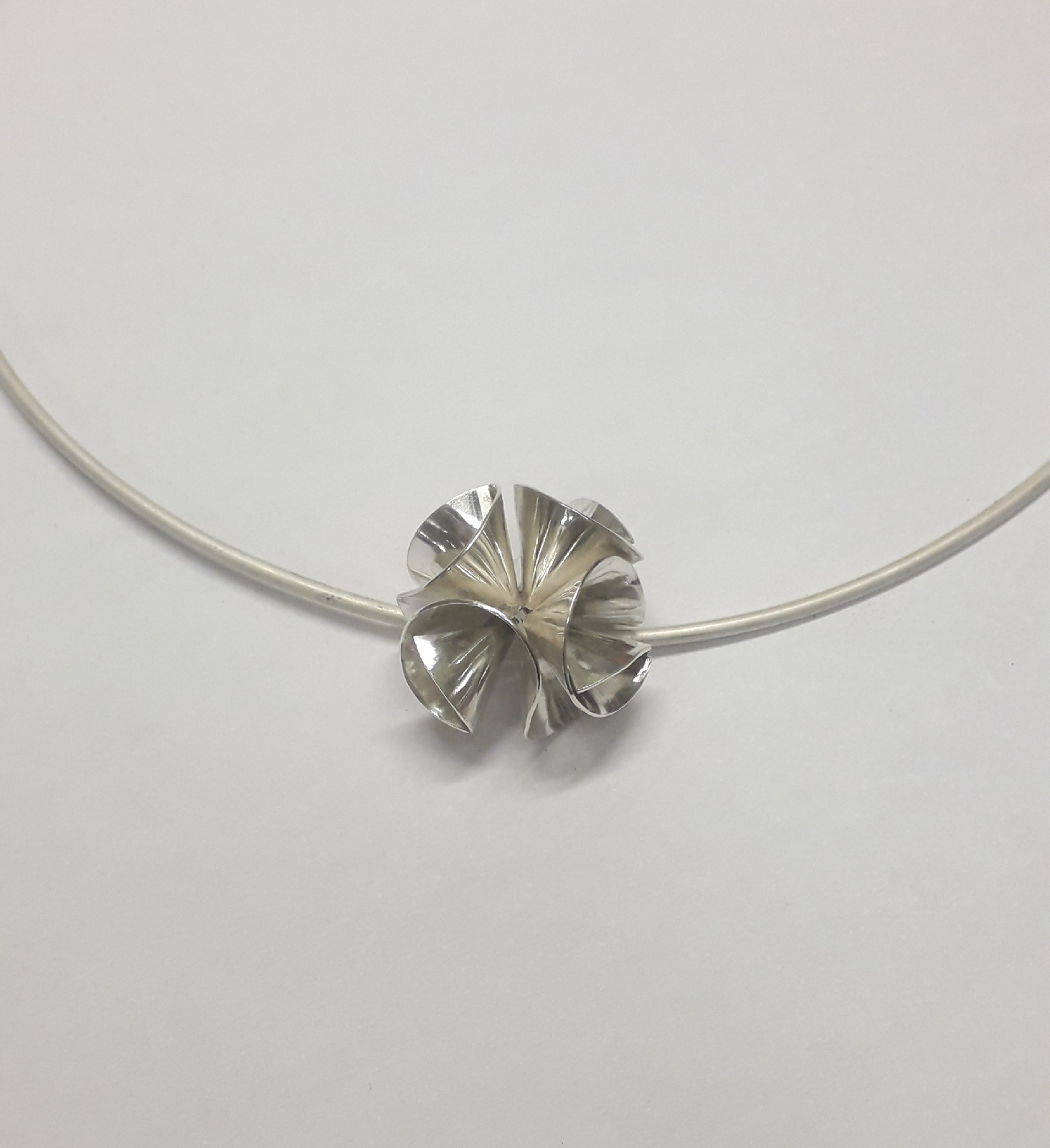
This is a silver fluted collection, inspired by the Fluted Swaddle. For this pendant, I had used the concept of folding and interlaced technique from the Platinum(finalist) earrings I made. Which had a punched out pattern on them but for this collection I wanted the overall shape to dominate more and not have patterns to interfere with the design. Firstly I start by bending the small S- shapes before interlacing them together without soldering to create this three-dimensional form, which I then soldered the thick wire to make a pendant and I added copper hooks for the earrings.
The reason why I made this collection because I wanted to capture the simplicity and the cleanness of the edges you get in fashion garments. I also wanted to capture the different folds and curves you get in the fabric when it is used as a headwrap.
Other Fabrics: African Wax Prints
Young (2016: 306) states that African wax prints, also known as Ankara or Dutch wax prints are colourful African cloths. The cloth is an important part of the material culture in Africa especially in the lives of women where it serves multifaceted roles in daily life. The cloth offers mystical protection against dangerous forces in society and holds deep spiritual meanings when used as part of rituals. African wax prints are prized possessions bestowed at life-changing events, such as coming-of-age ceremonies, customary marriage rites and baby naming ceremonies(ibid).
African wax prints are produced in various colours with intricate geometric or floral patterns see figure 1. It is mainly used for traditional clothing but the fashion industries have also adapted the African wax prints. As I have mentioned the offers of the cloth I want to emphasize the importance of the cloth as part of the African culture.
African wax prints are produced in various colours with intricate geometric or floral patterns see figure 1. It is mainly used for traditional clothing but the fashion industries have also adapted the African wax prints. As I have mentioned the offers of the cloth I want to emphasize the importance of the cloth as part of the African culture.
 |
Figure 1- Amooti Sharing Africa. (2017). Ankara Fabric. Wax Print. [ONLINE]
|
Monday, 7 October 2019
Isishweshwe
Isishweshwe is a printed dyed cotton fabric widely used for traditional South African clothing. According to Collins (2015), this fabric has been worn in traditional ceremonies in rural areas, for important occasions and national festivities. The fabric is now produced in various colours including the original indigo, red and brown, and a variety of shapes including diamonds, squares, stripes floral and circular geometric patterns (ibid).
:
 |
| Figure 2- Urbanstax. (2019). 7 Indigo Isishweshwe Quarters.[ONLINE] |
:
Sunday, 6 October 2019
Introduction
In Chapter two I will be looking at three relevant contemporary jewellers, two artists and one fashion designer. I have chosen these jewellers, artists and fashion designer because their work relates to different aspects of the jewellery I create.
Contemporary Jewellers
Contemporary Jewellers
- Ann Cole Jewellery - She uses a punching technique inspired by her surroundings.
- Julie Blyfield - She uses punching, chasing and repousse techniques and also create three-dimensional forms by folding.
- Hombisa Jewellery - He uses the milky way technique to emphasize or to create different images and patterns.
Artists
- Clement Mmaduako Nwafor - He emphasizes the importance of the cloth as part of African culture.
- Katanu Kay Sanna - She uses the African wax prints in another medium other than fashion.
Fashion Designer
- Khosi Nkosi - I will be looking at the visual aspects of the designed garments, the design elements and principles.
Friday, 4 October 2019
Fabric Motifs
A motif is "a decorative image or design, especially a repeated one forming a pattern" (Lexico Dictionary, 2019).
Motifs are repeated in different ways to create patterns and these patterns are repeated to create a design. They are often inspired by nature and "are also closely linked to natural, cultural, religious and socio-economic factor prevailing in any society"(Pheto-Moeti et al. 2017: 28).
I think fabric motifs designs can be classified as:
I think fabric motifs designs can be classified as:
- Geometric
- Natural
Geometric Motifs
These motifs include lines in various forms, such as vertical, horizontal, diagonal and curved. They create fabric designs, such as stripes, plaids, checks, circles and other associated designs, see figure 1.
Figure 2 is an example of the geometric motifs in Isishweshwe fabrics.
 | ||
Figure 1-Buckley, C., (2012). Geometric Motifs. [ONLINE]
|




Natural Motifs
They portray a direct replica of things as they exist in nature, such as flowers on trees, animals, human figures and other natural things, see Figure 4 is an example of a natural motif used fabric.
 |
| Figure 4- Digital Wax Print., (2012). Ukhozi. Isishweshwe with a Picture of an Eagle. [ONLINE] |
Wednesday, 2 October 2019
Contemporary Jewellery
The word Contemporary is defined as the "present times or belonging to the same time"(Lexico Dictionary). I have looked at den Besten's(2011: 9) paper where he states that "contemporary jewellery indicates that it is made now and that it is 'of our time' whereas it covers a period that spans at least forty-five years". Yes contemporary jewellery is made now but they are different categories you need to look at before applying the word contemporary in your work
Categories of Contemporary Jewellery
In the list below den Besten identifies the various categories that jewellery can fit into:
1. Contemporary - Jewellery that is made now and here
2. Studio Jewellery - Jewellery that is produced by individuals in their studios
3. Art Jewellery - Jewellery that indicates that either art and jewellery are similar or that jewellery as an art form.
4. Research Jewellery - Jewellery that can be explained as a way to describe the artistic process.
5. Jewellery Design - Jewellery that is designed by the designer who doesn't manufacture it.
6. Author Jewellery - Jewellery made by an individual and bears the stamp of his or her artistry and vision.
The most relevant categories I will be looking at are studio and author jewellery
The aim for studio jewellers is to "control every aspect of producing a piece of jewellery from original idea to finished work"(den Besten 2011: 10). I think that studio jewellery is a big part of the contemporary jewellery I create.
According to de Besten (2011: 10-11), author jewellery is made by a single jeweller and bears the stamp of their artists and his/her vision. The idea is that there is an ongoing artistic 'standard or reference' that can progress from one collection to the next (ibid). Finding an ongoing theme and developing relevant techniques in my work is another contemporary jewellery quality I will be considering.
The most relevant categories I will be looking at are studio and author jewellery
The aim for studio jewellers is to "control every aspect of producing a piece of jewellery from original idea to finished work"(den Besten 2011: 10). I think that studio jewellery is a big part of the contemporary jewellery I create.
According to de Besten (2011: 10-11), author jewellery is made by a single jeweller and bears the stamp of their artists and his/her vision. The idea is that there is an ongoing artistic 'standard or reference' that can progress from one collection to the next (ibid). Finding an ongoing theme and developing relevant techniques in my work is another contemporary jewellery quality I will be considering.
Tuesday, 17 September 2019
Punched out disks with melted beads
 |
| Figure 1- Nkabinde, M,. (2018). Silver with glass beads disks. |
The reason why I had done this experiment because I wanted to find another way of adding colour in my work other than stringing beads on. I really liked the outcome these disks and I didn't want to make any jewellery piece out of it because I wouldn't be able to hold it up against the light to see the beautiful effect it has with the different colour coordination.
Fabric Texture on Copper forms
 |
| Figure 1- Nkabinde, M., (2019). Copper and Silver collar necklace. |

 |
Figure 2- Nkabinde, M., (2019). Copper and Silver collar necklace.
|

I decided to use a thin copper plate so I can be able to fold it in a form of how the tailors fold their fabrics. Then I decided to use the actual isishweshwe fabric to get the texture into copper by using the roll-milling technique. Folding the piece of copper was a bit challenging because I had to make sure that is it folded equally, the spaces in between are even. I ended up not getting the even folds, which made me realise that I am working with a different medium which is metal and I won't get the exact result as you do with fabric. It will take lots of practice to get it right but I am happy with the result because I've learnt that you cant approach things the same way as other people are doing it you might have to find your own approach to make something work.
Subscribe to:
Posts (Atom)