Showing posts with label chapter 3. Show all posts
Showing posts with label chapter 3. Show all posts
Sunday, 20 October 2019
Conclusion for Chapter Three
In this chapter, I have discussed my body of work and I am very pleased with the outcome. In creating this body of work I have faced many challenging's and one of the biggest challenges has to do with being stuck on one idea and not allowing myself to think outside of the box. With my jewellery pieces that I have made I'm happy to say that I can see the growth/development from the first piece of jewellery I made to the very last. Hence I take b-tech as a foundation phase of discovering your style and interest in jewellery. I also took it as a matter of developing your techniques and finding your strongest field in manufacturing and designing jewellery. I think I have an idea of what I want to focus on in the future and that is looking more into fashion. I want to find a fashion field that excites me the most with relevant elements and aspects that I can use to create fashion jewellery.

Introduction to Chapter Three
In this chapter, I will discuss how I have used Isishweshwe fabric as inspiration to create contemporary jewellery. I have used patterns, colours, and texture from the fabric and I will discuss how I have incorporated these aspects in my work. I have shown the work of other jewellers and fashion designers in chapter two to give an overview of the style of work that I produced in this chapter, with specific elements taken from their work. Then I will discuss the design process and the techniques I have used and also show the development through prototypes.
Tuesday, 15 October 2019
Isishweshwe and Ankara fabrics worn in a traditional ceremony
 |
| Figure 1- Nkabinde, M., (2019). Isishweshwe and Ankara garments. |

Anglo Plat Prototype
 |
| Figure 1- Nkabinde, M., (2019). Silver Earrings. |
I had used the folded element from the dress worn by the bride and I also abstract few elements from the head-wrap, how it forms those curves at the edges and the whole three-dimensional form the head-wrap create. I had to test how the folding was going to work with copper first before making the prototype, and I was very happy with the results, I had to make sure I used a thin plate so I can get nice curves. This pair of earrings represent all the struggles and all the good times you get in a relationship before the commitment. I wanted to make something that withholds the good and the bad in one but with a beautiful look on the outside.

Monday, 14 October 2019
Punched Disks
 |
| Figure 1- Nkabinde, M., (2018). Silver and Brass disks. |

Twirling Punched Earrings
 |
| Figure 1- Nkabinde, M., (2018). Twirling Punched Earrings. Silver. |
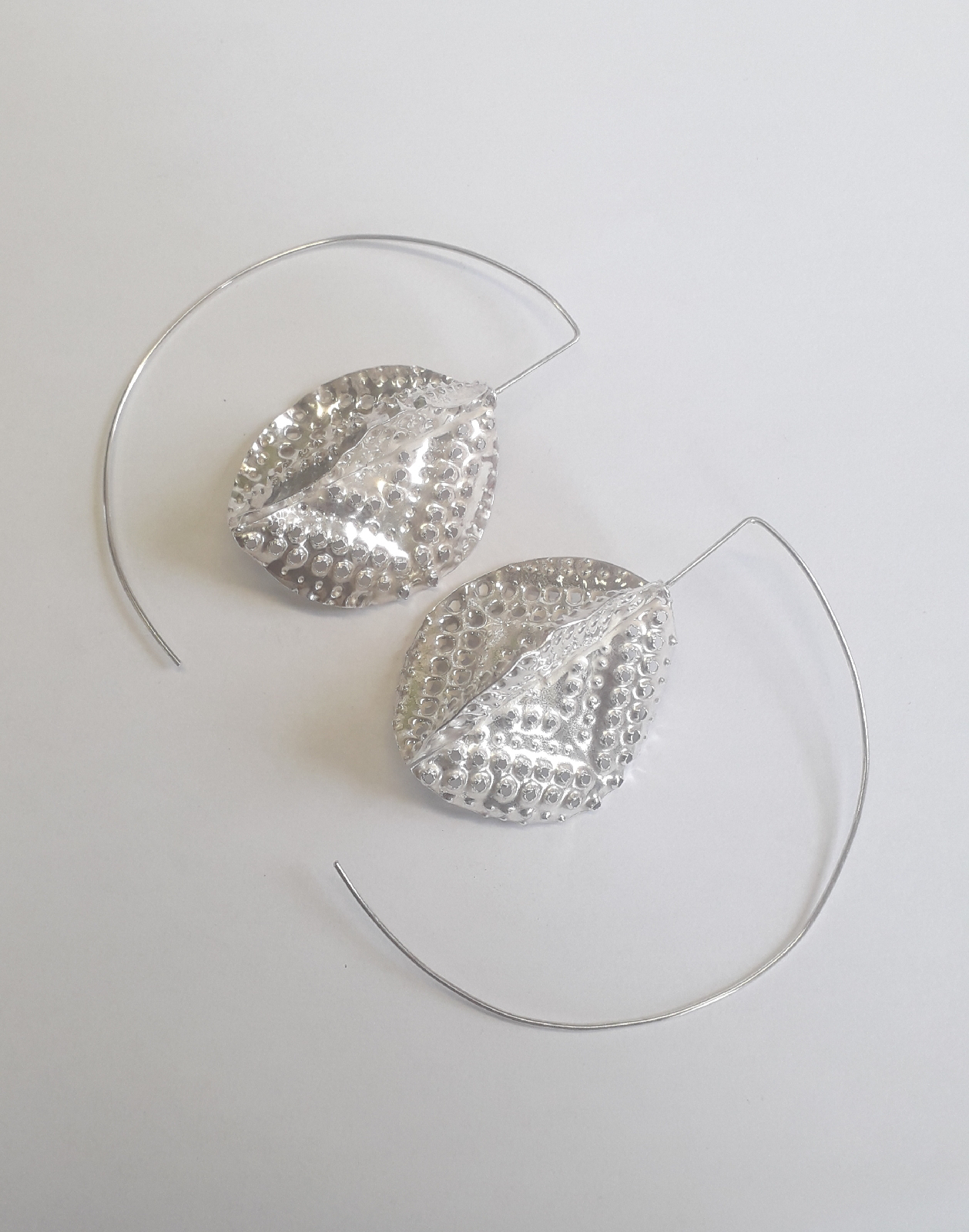
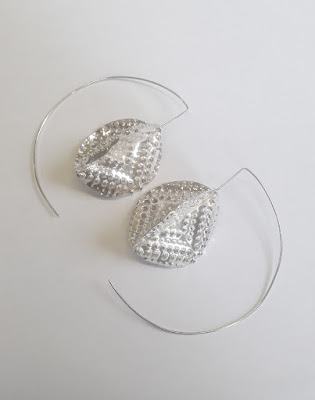
I had used the pattern template from the previous test pieces and prototypes but I decided to punch the patterns in different directions to represent the spots and the different stages you get in a relationship. The patterns punched in a very thin plate and I would allow the punch to go through the plate to allow the metal to form fluted edges. If you put the earrings together the hooks form a circular shape which symbolizes infinity. I made these earrings because I wanted to show different stages in a relationship using punching and patterns from Isishweshwe to give visual aspects of how fabric can be used in another medium.
Friday, 11 October 2019
Punched Disks Earrings
 |
| Figure 1- Nkabinde, M., (2018). Silver Punched Earrings. |

I wasn't really pleased with the outcome of these earrings because they were flat they didn't have any three-dimensional feel or look at all, but I was happy at how the punching looked like and you could actually see the flow of the patterns. This motivated me to look into a three-dimensional form and see how I can incorporate it in my work.
Fabric Earrings
 |
| Figure 1- Nkabinde, M., (2019). Copper and Silver Earrings. |
I had used a thin copper plate and a piece of cloth for roll-milling to get the texture then I used my hands and a pair of pliers here and there to get that folded look. The concept derived from the collar necklace I made as a statement piece with different aspects abstracted from Nkosi's garments. The reason why I made this pair of earrings because I wanted to find different ways to capture the beauty of the fabric through the visual aspects found in fashion or used in fashion.

The Fluted Collection
 |
| Figure 1- Nkabinde, M. (2019). Fluted Earrings. |
 |
| Figure 2- Nkabinde, M., (2019). Silver Fluted Pendant. |
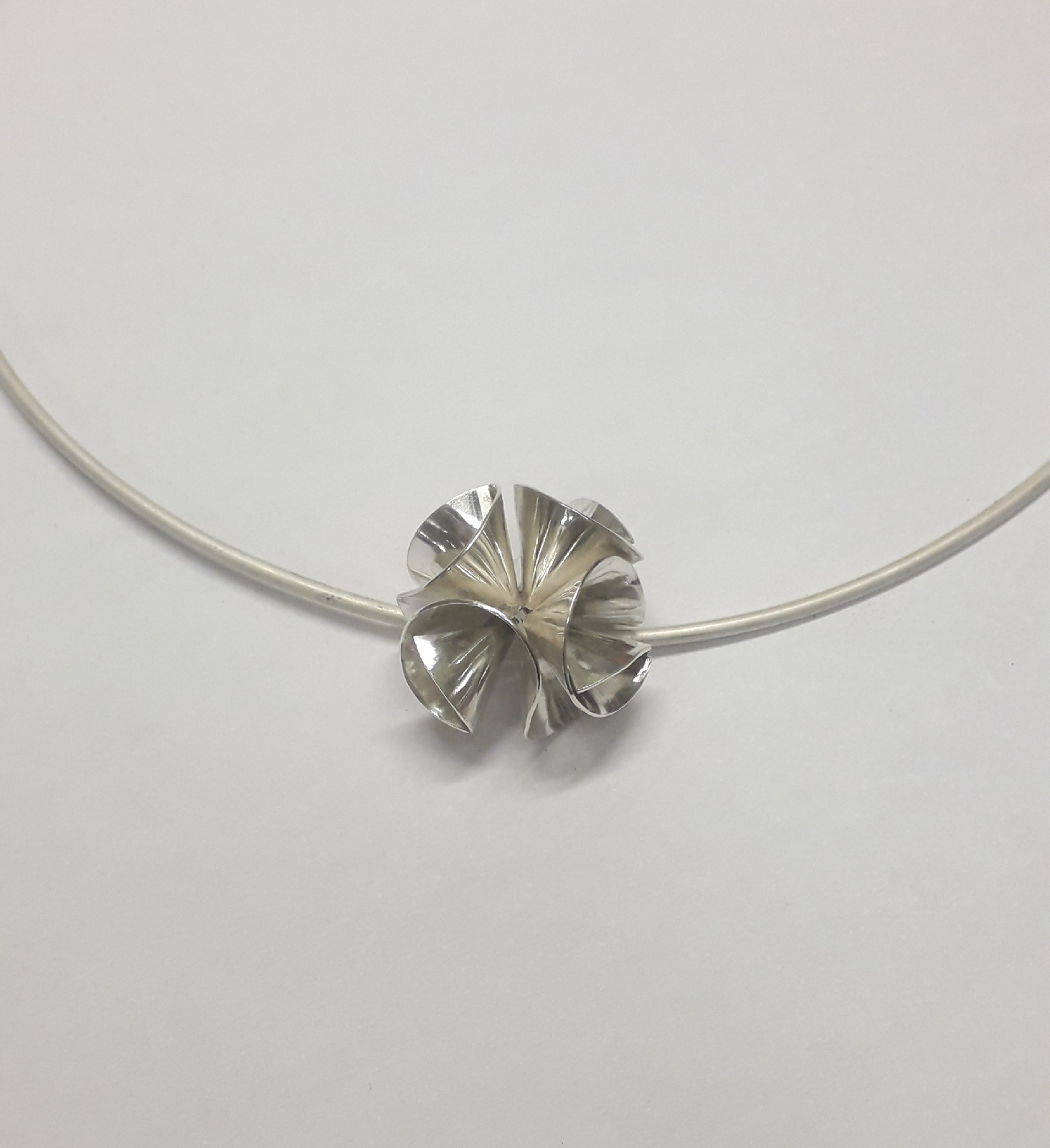
This is a silver fluted collection, inspired by the Fluted Swaddle. For this pendant, I had used the concept of folding and interlaced technique from the Platinum(finalist) earrings I made. Which had a punched out pattern on them but for this collection I wanted the overall shape to dominate more and not have patterns to interfere with the design. Firstly I start by bending the small S- shapes before interlacing them together without soldering to create this three-dimensional form, which I then soldered the thick wire to make a pendant and I added copper hooks for the earrings.
The reason why I made this collection because I wanted to capture the simplicity and the cleanness of the edges you get in fashion garments. I also wanted to capture the different folds and curves you get in the fabric when it is used as a headwrap.
Tuesday, 17 September 2019
Punched out disks with melted beads
 |
| Figure 1- Nkabinde, M,. (2018). Silver with glass beads disks. |
The reason why I had done this experiment because I wanted to find another way of adding colour in my work other than stringing beads on. I really liked the outcome these disks and I didn't want to make any jewellery piece out of it because I wouldn't be able to hold it up against the light to see the beautiful effect it has with the different colour coordination.
Fabric Texture on Copper forms
 |
| Figure 1- Nkabinde, M., (2019). Copper and Silver collar necklace. |

 |
Figure 2- Nkabinde, M., (2019). Copper and Silver collar necklace.
|

I decided to use a thin copper plate so I can be able to fold it in a form of how the tailors fold their fabrics. Then I decided to use the actual isishweshwe fabric to get the texture into copper by using the roll-milling technique. Folding the piece of copper was a bit challenging because I had to make sure that is it folded equally, the spaces in between are even. I ended up not getting the even folds, which made me realise that I am working with a different medium which is metal and I won't get the exact result as you do with fabric. It will take lots of practice to get it right but I am happy with the result because I've learnt that you cant approach things the same way as other people are doing it you might have to find your own approach to make something work.
Tuesday, 3 September 2019
Anglo Plat 2019
 |
Figure 1- Nkabinde, M., (2019). Fluted Swaddle. Platinum Earrings.
|
These are platinum earrings with cubic zirconia set in a tube setting, designed for the Anglo Platinum Competition 2019. Which I was selected to be one of the finalists. I had to change the metal thickness only from the silver prototype to make sure that I had enough metal to work with. I really enjoyed this project because we were given a theme: Your Love Has Gone Platinum which I think I interpreted it in an understandable way that relates to my work.
Here is the free writing I had to do that goes with my piece:
Umembeso is a symbol of a remarkable and meaningful journey that Nkanyiso and Senhle are about to take. It is a way of showing mutual respect and commitment to each other. During this ceremony, the family dresses the bride in a respective way that they would want her to look in the future.
Nkanyiso and Senhle are both young and modern but they stick to traditions that they learned growing up. They have been living together and planning this ceremony, then Nkanyiso thought of how he could bring the whole concept of a head wrap into something elegant yet a statement that his wife can wear on her big day or any other day. A headwrap is a sign of respect to her in-laws and husband therefore, I have used the idea of how the fabric folds and curl as a head wrap into a unique pair of earrings that symbolizes respect, genuine and authentic love.
I have used patterns from the head wrap fabric as my main focus, I decided to punch out patterns that are inspired by Isishweshwe into metal and I have used the concept of the fold-up fabric as an overall pattern to create the swirly and fluted look in the earrings. Platinum is a symbol of everlasting and pure love because it doesn’t tarnish it is always shiny and keeping the spark alive.
Anglo Platinum 2018
 |
| Figure 1- Nkabinde, M., (2019). The Seed: Imbewu. Platinum with glass beads. |
Friday, 17 May 2019
Platinum Prototype in silver
 |
| Figure 2- Nkabinde, M.,(2019). Silver. |
 |
Figure 1- Nkabinde, M., (2019). Fabric.
|
 |
| Figure 3- Nkabinde, M., (2019). Silver. |
 |
| Figure 4- Nkabinde, M., (2019). Silver. |
 |
| Figure 5- Nkabinde, M., (2019). Silver. |
Wednesday, 15 May 2019
Copper Disks with Different Pattern Imprints
 |
| Figure 1- Nkabinde, M., (2019). Copper and glass beads. |
 |
| Figure 2- Nkabinde, M., (2019). Copper and glass beads. |
Friday, 10 May 2019
Platinum design exploration


These are patterns I've been working with lately, I've decided to work with copper to see if i get the same results as silver and it turned out beautiful with the patterns but i feel like the colours don't pop out nicely in copper. so now i know which metal works beautiful with my melted beads
Thursday, 13 September 2018
Colour Arrangement
 |
| Figure 1- Nkabinde, M., (2018). Silver with glass beads. |
 |
| Figure 2- Nkabinde, M., (2018). Silver with glass beads. |
In figure 1&2 show the different colour arrangement I am working or I have to choose from.
Rectangular Elements
 |
| Figure 1- Nkabinde, M., (2018). Silver with glass beads elements. |

These are silver and melted glass beads elements I was planning to use for the Jewellex Competition themed: Retro. This was the first piece I made for my b-tech that didn't work out, I had used a thicker plate for the imprints which made it very difficult for the beads to melt. I also noticed that the actual rectangular shape of the element was not working for this particular technique because the beads wouldn't stay in place and they started cracking when i was joining the two pieces together to from that three dimensional form. I had been working with two different colour arrangement but I chose the one in figure 1 because I thought it dominated more then the other one.
What I learnt from this project is that you can't apply the same technique to different shapes because they differ in reactions.
Pattern Imprints
 |
| Figure 1- Nkabinde, M., (2018). Silver strips. |
 |
| Figure 2- Nkabinde, M., (2018). Silver strips |
Thursday, 30 August 2018
Experiment for Jewellex earrings design
Playing with my torch and getting beautiful colour transformation in figure 1 the metal is still hot then in figure 2 it has cools down leaving that glossy look at the top.
 |
Figure 1- Nkabinde, M., (2018). Silver disks with melted beads.
|

 |
| Figure 2- Nkabinde, M., (2018). Silver disks with melted beads. |

Subscribe to:
Posts (Atom)