Showing posts with label chapter 2. Show all posts
Showing posts with label chapter 2. Show all posts
Sunday, 20 October 2019
Conclusion for Chapter Two
In this chapter, I have looked at different contemporary jewellers, artists and fashion designers. Out of all the artists I have mentioned I realised that I have taken different aspects of their work which relates to my interest. The different aspects I have looked at is the concept of how fabric is being used, the unique techniques and the methods used in their work. I have taken all these aspects into consideration and they have helped me in creating the body of work in chapter three.

Sunday, 6 October 2019
Introduction
In Chapter two I will be looking at three relevant contemporary jewellers, two artists and one fashion designer. I have chosen these jewellers, artists and fashion designer because their work relates to different aspects of the jewellery I create.
Contemporary Jewellers
Contemporary Jewellers
- Ann Cole Jewellery - She uses a punching technique inspired by her surroundings.
- Julie Blyfield - She uses punching, chasing and repousse techniques and also create three-dimensional forms by folding.
- Hombisa Jewellery - He uses the milky way technique to emphasize or to create different images and patterns.
Artists
- Clement Mmaduako Nwafor - He emphasizes the importance of the cloth as part of African culture.
- Katanu Kay Sanna - She uses the African wax prints in another medium other than fashion.
Fashion Designer
- Khosi Nkosi - I will be looking at the visual aspects of the designed garments, the design elements and principles.
Wednesday, 4 September 2019
Hombisa Jewellery
Hombisa (to decorate, in Xhosa,) was founded in 2008 by Vincent Lourens. Lourens is a contemporary jeweller living in Stellenbosch, South Africa. He has been developing and expanding his skills for the last 18 years and has created a unique and instantly recognisable style drawn from the broad array of his interests, influences, and inspirations. (Hombisa Jewellery. 2017)
"The source of inspiration for many of the jewellery pieces in his collection comes straight from nature (figure 1). Whether it is a fern leaf, an ocean wave or a sea shell, anything can serve as a starting point to create something new and unique. It allows him to make powerful items of adornment, jewellery that evokes feelings and emotions to the wearer". (Hombisa Jewellery. 2017)
Lourens (2017) developed a technique called The Milky Way. He works with selected exotic and African hardwoods. Holes as tiny as 0.2 mm are drilled, which are then painstakingly filled with precious metal wire one hole at a time. The effect this creates is similar to looking at the scattering of the stars in the African night sky (figure 2).
A link can be drawn between Lourens jewellery and my work. The milky way technique has been his style of recognition, I have taken the technique idea, developed it and made it my own. He also uses inspiration from his surroundings including patterns taken from Isishweshwe and that is similar to how I use Isishweshwe as my source of inspiration. The picture below shows how he interprets the Shweshwe patterns, uses his techniques to create jewellery with an African feel.
"The source of inspiration for many of the jewellery pieces in his collection comes straight from nature (figure 1). Whether it is a fern leaf, an ocean wave or a sea shell, anything can serve as a starting point to create something new and unique. It allows him to make powerful items of adornment, jewellery that evokes feelings and emotions to the wearer". (Hombisa Jewellery. 2017)
 |
| Figure 1- Hombisa Jewellery., (2010). Dandelion Pendant. African Blackwood, 18ct Yellow Gold, Silver, .50 Point Yellow and .40 Cognac Diamond. [ONLINE] |
Lourens (2017) developed a technique called The Milky Way. He works with selected exotic and African hardwoods. Holes as tiny as 0.2 mm are drilled, which are then painstakingly filled with precious metal wire one hole at a time. The effect this creates is similar to looking at the scattering of the stars in the African night sky (figure 2).
 |
| Figure 2- Hombisa Jewellery., (2009). The Galaxy. African Blackwood, 18ct White Gold, Silver and .60 Point Yellow Diamond Pendant. [ONLINE] |
 |
| Figure 3- Hombisa Jewellery., (2010). Shweshwe Earrings. 18ct Yellow Gold and Sterling Silver with 10 Point Brilliant Diamonds set in Makassar Ebony. [ONLINE] |
Julie Blyfield
According to Feagins (2011), Julie Blyfield is a well-known Australian artist. Blyfield's work is based on the realm of nature around her. She manages to capture what is beautiful and unique about Australian natural landscape and uses that as a starting point (ibid).
 |
| Figure 1- Blyfield, J., (2010). Scintilla Series. Silver Vessels. [ONLINE] |
 |
| Figure 2- Blyfield, J., (2009). Pressed Desert Plant Brooches. Blackened Silver, Paint and Wax. [ONLINE] |
 |
| Figure 3- Blyfield, J. (2014). Earrings. Sterling Silver, Blackened Silver and Gold Plated Silver. [ONLINE] |
Friday, 31 May 2019
Khosi Nkosi
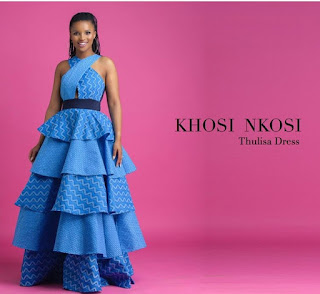
"Khosi Nkosi is a fashion brand established in 2008 by a designer named Nobukhosi Nkosi. The brand name is derived from the Zulu word for royalty and features chic ruffled dresses in traditional African print. The garments are a perfect fusion of traditional and modern taste. She plays around with African prints creating garments that incredible fits on the wearer. Nkosi's collection is perfect for every occasion like wedding, birthdays and office parties, see figure 1"(Hume. n.d).
 |
| Figure 1- Nkosi, N. Stretch Shweshwe. [ONLINE] |
"The Khosi Nkosi garments are inspired by what the brand essence for: Strong. Modern, Worldly, Nubile woman that loves and respects herself and pays attention to detail"(Nkosi. n.d).
I think her aim is to make garments that are appropriate for every woman with different fashion taste.
I have noticed a style that she uses in most of her garments which is the different layers she create in a dress giving different dimensions, symmetrical and asymmetrical look, see figure 1 &2. I have been working with different layers and folding in my jewellery inspiration drawn from Nkosi's garments.
 |
| Figure 2- Nkosi, N. Thulisa Dress. [ONLINE] |
Wednesday, 22 May 2019
Clement Mmaduako Nwafor
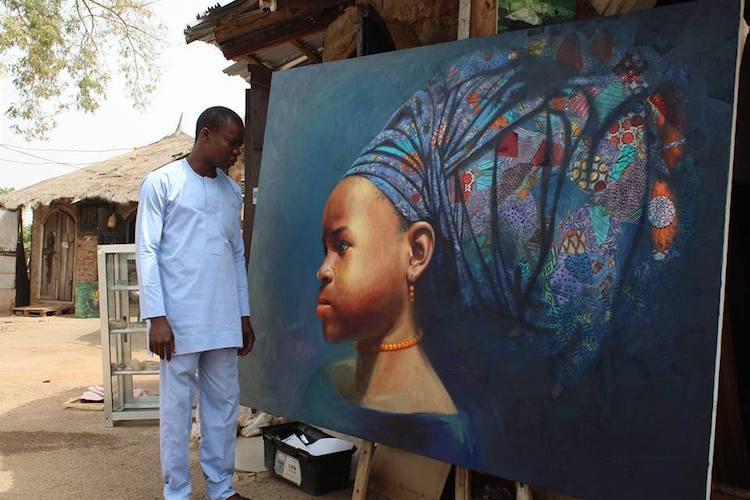
Clement Mmaduako is an award winning contemporary Nigerian artist and the creative art director of Clemspeter Art Creation Limited. Stewart (2018: para 1 line 1) states that he creates realistic oil portraits incorporating colourful traditional fabric. Clement works with oil paints and collage to create stunning, large-scale paintings on canvas, see Figure 1. His work mainly focuses on portraiture.
 |
| Figure 1- Nwafor, C. N. (2018). Large-scale painting on canvas. [ONLINE] |
Clement uses Nigerian headwraps (gele) as a big feature in his work, he uses different pieces of fabric, resulting a stunning mixed media artwork, see figure 2. I like the realistic look of the fabric in his painting and how he has uses the contrast of colours which draws a link between his work and mine. I want to capture the importance of the traditional fabric by using the elements of the headwraps from his paintings.
 |
| Figure 2- Nwafor, C. M. (2018). The Gele. Oil painting on canvas. [ONLINE] |
Woman wear head-wraps for different occasions whether its for religious, cultural reasons and even as a fashion statement but traditionally in my culture headwraps are usually worn by married women. I admire his work so much because through his artwork he speaks highly of social identity and how woman can be celebrated through art. A head-wrap is a significance of respect and to me respect\ Ukuhlonipha ukuzazi ubuwena futhi ukuziqhenya ngemvelaphi yakho.
Wednesday, 15 May 2019
Katanu Kay Sanna

Mbaya (2017: para. 2 line 1) states that Katanu Kay is a 19 year old Kenyan artist who uses traditional African fabric in her artwork. She create sculptural pieces that utilize fabric- African fabric at that, to convey colour, movement and emotions.
She started using kitenge fabric in her work when she was doing her art assignment. Where they were given a scenario to design a wall hangings for the lobby at a lodge in Masai Mara. So, she thought 'lions are animals often associated with African culture and so are kitenge fabrics', see figure 1. She merged the two and loved the outcome then she moved to mixing kitenge fabric with other paintings.(Orubo, D. 2017: 2)
 |
| Figure 1- Sanna, K. (2017). The Original Lion. Painting with Kitenge Fabric. [ONLINE] |
I really like how she completes her painting with the touch of traditional fabric. This has come to a point where I have noticed that she uses the significant of this African fabric to form part of a cultural identity. A link can be drawn between her work and mine through the embracing and modernizing of traditional fabrics that resembles home as in 'Africa'. The actual fabric has been used in her artwork and I wanted to show that it is not only used in clothing but they are different ways to portray the message within the fabric. That is similar to what I want with my jewellery.
Monday, 15 April 2019
Ann Cole Jewellery
Taryn Coleman is the founder of Ann Cole Jewellery based in Durban.
According to Coleman (n.d), her jewellery is an expression of love for the serenity of the natural world. From the ocean to the earth and even the stars, I seek to capture and mimic the poetry of natural creations using precious metals and specialised handcrafted jewellery techniques. With a transcendental perspective, my design explores the seemingly supernatural patterns and formations found in nature.
Coleman uses punches fabricated and shaped by hand to create some of her jewellery, see Figure 1 showing the basic tools she uses for her imprints. In 2009 she did her B-tech, that is when she discovered the imprinting technique that she uses in some of her jewellery.
 |
| Figure 1- Ann Cole Jewellery. 2019. Imprinting Tools [ONLINE]. |
In figure 2 is an example of her work done during her b-tech days, it is a good example of what I am aiming to get at the end of my b-tech. I can pinpoint lots of similarities between her work and mine, from the imprinting\ punching technique to the inspiration drawn from Isishweshwe fabric patterns, see figure 3 where she create platinum earrings inspired by Isishweshwe. I have noticed that not all of her jewellery pieces were inspired by Isishweshwe but I like how she takes pattern from her surroundings and make them her own through the imprinting and allowing the metal to speak for itself.
 |
Figure 2- Ann Cole Jewellery. (2018). Wabi-Sabi. Copper cuff [ONLINE].
|
 |
| Figure 3- Ann Cole Jewellery. (2017). Isishweshwe inspired Platinum earring [ONLINE]. |
Subscribe to:
Posts (Atom)