I have looked at different types of African fabrics and I have noticed that these fabrics are not only used for clothing, but they are used for different purposes in different cultures. I have focused mainly on Isishweshwe fabric because it is one of the fabrics that was introduced to me at a younger age as part of my traditional clothing collection.
For the past few years, I have only known Isishweshwe as a South African fabric and only used by the African people. Having the research done and learning about the origins of Isishweshwe, I have realised that African people have not only adapted certain aspects of the fabric, but we have made it our own. African people saw the need to use this fabric as part of our national identity.
Showing posts with label chapter 1. Show all posts
Showing posts with label chapter 1. Show all posts
Sunday, 20 October 2019

Sunday, 13 October 2019
Introduction to Chapter One
In chapter one, I will be defining the terminologies of my working title which is Using Isishweshwe to create Contemporary Jewellery. To make sure the reader has an understanding of the idea that will be discussed throughout this report. Firstly I will discuss the history of Isishweshwe including the important characteristics, the naming, fabric motifs, and the uses of Isishweshwe. I will also look at other African wax prints to give another perspective view of the important characteristics of the fabrics other than fashion. Then I will discuss contemporary jewellery according to Metcalf and Den Besten with relates to my work.
Friday, 11 October 2019
Other Fabrics: African Wax Prints
Young (2016: 306) states that African wax prints, also known as Ankara or Dutch wax prints are colourful African cloths. The cloth is an important part of the material culture in Africa especially in the lives of women where it serves multifaceted roles in daily life. The cloth offers mystical protection against dangerous forces in society and holds deep spiritual meanings when used as part of rituals. African wax prints are prized possessions bestowed at life-changing events, such as coming-of-age ceremonies, customary marriage rites and baby naming ceremonies(ibid).
African wax prints are produced in various colours with intricate geometric or floral patterns see figure 1. It is mainly used for traditional clothing but the fashion industries have also adapted the African wax prints. As I have mentioned the offers of the cloth I want to emphasize the importance of the cloth as part of the African culture.
African wax prints are produced in various colours with intricate geometric or floral patterns see figure 1. It is mainly used for traditional clothing but the fashion industries have also adapted the African wax prints. As I have mentioned the offers of the cloth I want to emphasize the importance of the cloth as part of the African culture.
 |
Figure 1- Amooti Sharing Africa. (2017). Ankara Fabric. Wax Print. [ONLINE]
|
Monday, 7 October 2019
Isishweshwe
Isishweshwe is a printed dyed cotton fabric widely used for traditional South African clothing. According to Collins (2015), this fabric has been worn in traditional ceremonies in rural areas, for important occasions and national festivities. The fabric is now produced in various colours including the original indigo, red and brown, and a variety of shapes including diamonds, squares, stripes floral and circular geometric patterns (ibid).
:
 |
| Figure 2- Urbanstax. (2019). 7 Indigo Isishweshwe Quarters.[ONLINE] |
:
Friday, 4 October 2019
Fabric Motifs
A motif is "a decorative image or design, especially a repeated one forming a pattern" (Lexico Dictionary, 2019).
Motifs are repeated in different ways to create patterns and these patterns are repeated to create a design. They are often inspired by nature and "are also closely linked to natural, cultural, religious and socio-economic factor prevailing in any society"(Pheto-Moeti et al. 2017: 28).
I think fabric motifs designs can be classified as:
I think fabric motifs designs can be classified as:
- Geometric
- Natural
Geometric Motifs
These motifs include lines in various forms, such as vertical, horizontal, diagonal and curved. They create fabric designs, such as stripes, plaids, checks, circles and other associated designs, see figure 1.
Figure 2 is an example of the geometric motifs in Isishweshwe fabrics.
 | ||
Figure 1-Buckley, C., (2012). Geometric Motifs. [ONLINE]
|

Natural Motifs
They portray a direct replica of things as they exist in nature, such as flowers on trees, animals, human figures and other natural things, see Figure 4 is an example of a natural motif used fabric.
 |
| Figure 4- Digital Wax Print., (2012). Ukhozi. Isishweshwe with a Picture of an Eagle. [ONLINE] |
Wednesday, 2 October 2019
Contemporary Jewellery
The word Contemporary is defined as the "present times or belonging to the same time"(Lexico Dictionary). I have looked at den Besten's(2011: 9) paper where he states that "contemporary jewellery indicates that it is made now and that it is 'of our time' whereas it covers a period that spans at least forty-five years". Yes contemporary jewellery is made now but they are different categories you need to look at before applying the word contemporary in your work
Categories of Contemporary Jewellery
In the list below den Besten identifies the various categories that jewellery can fit into:
1. Contemporary - Jewellery that is made now and here
2. Studio Jewellery - Jewellery that is produced by individuals in their studios
3. Art Jewellery - Jewellery that indicates that either art and jewellery are similar or that jewellery as an art form.
4. Research Jewellery - Jewellery that can be explained as a way to describe the artistic process.
5. Jewellery Design - Jewellery that is designed by the designer who doesn't manufacture it.
6. Author Jewellery - Jewellery made by an individual and bears the stamp of his or her artistry and vision.
The most relevant categories I will be looking at are studio and author jewellery
The aim for studio jewellers is to "control every aspect of producing a piece of jewellery from original idea to finished work"(den Besten 2011: 10). I think that studio jewellery is a big part of the contemporary jewellery I create.
According to de Besten (2011: 10-11), author jewellery is made by a single jeweller and bears the stamp of their artists and his/her vision. The idea is that there is an ongoing artistic 'standard or reference' that can progress from one collection to the next (ibid). Finding an ongoing theme and developing relevant techniques in my work is another contemporary jewellery quality I will be considering.
The most relevant categories I will be looking at are studio and author jewellery
The aim for studio jewellers is to "control every aspect of producing a piece of jewellery from original idea to finished work"(den Besten 2011: 10). I think that studio jewellery is a big part of the contemporary jewellery I create.
According to de Besten (2011: 10-11), author jewellery is made by a single jeweller and bears the stamp of their artists and his/her vision. The idea is that there is an ongoing artistic 'standard or reference' that can progress from one collection to the next (ibid). Finding an ongoing theme and developing relevant techniques in my work is another contemporary jewellery quality I will be considering.
Thursday, 26 September 2019
Tradition and Culture
"Traditions represent a critical piece of our culture. They help form the structure and foundation of our families and our society. They remind us that we are part of a history that defines our past, shapes who we are today and who we are likely to become"(Sonnenberg. 2015: 1)
In the article, Difference between Culture and Tradition (2017: para.1 line1) culture discussed as a complex concept that incorporates the combination of people's values, beliefs and personal interests. It is what defines a group of people living in a certain area of the globe or people who share a type of heritage.
According to Leeb-du Toit(2017: 9), black South Africans have, in particular, been adamant that the Isishweshwe cloth represents a salient part of their culture. Culture is important because it allows people to maintain a unique social identity and have common interests, while others may have customs that differ greatly from another. As a whole, culture is conclusive of human growth as a society and it is not based on genetics alone. Whereas traditions are a part of the cultural cluster of human actions.
Thursday, 29 August 2019
The Historical Origins of Isishweshwe
I have looked at the historical origins of Isishweshwe to help me and the reader understand or to
have an idea of how the blue cloth was discovered in South Africa. According to Pheto- Moeti
(2017: 25) Isishweshwe or blue cloth originated in Europe from cloth imported from India.
During the 19th century, the European textile manufacturers developed a printing style on
indigo-dyed cotton fabric see Figure 1 because the plant used for indigo dye could not grow
in the cold European climate (ibid).
 |
| Figure 1: The Invention of Copper Engraving, plate 19 |
Pheto- Moeti et al (2017: 25) states that around 1890 a German factory developed a synthetic
indigo dye that is still used today. The fabric was manufactured and printed in Czechoslovakia
and Hungary by Gustav Deutsch, who migrated to England in the 1930s. Where the factory
was later bought by Blue Printers Ltd in Wigan. Four companies were producing this print style,
the largest being Spruce Manufacturing which produced the most popular brand name of Three Cats, which was exported to South Africa
The blue cloth was introduced to South Africa by the German Settlers in 1858/9 after they settled in the Eastern Cape and Natal. The fabric was imported from Europe to meet the demand of the German settler women, African women had gradually replaced their animal skin garments with cotton ones, they began to dress in European style dresses see figure 2&3
the largest being Spruce Manufacturing which produced the most popular brand name of Three Cats, which was exported to South Africa
The blue cloth was introduced to South Africa by the German Settlers in 1858/9 after they settled in the Eastern Cape and Natal. The fabric was imported from Europe to meet the demand of the German settler women, African women had gradually replaced their animal skin garments with cotton ones, they began to dress in European style dresses see figure 2&3


Isishweshwe Design Names
According to Leeb- du Toit (2017: 260) naming isishweshwe design is a significant aspect of their
indigenisation over time. Owners of textiles outlets throughout Southern African have contributed
largely to this naming, thereby facilitating their ordering and identification of isishweshwe designs for customers, although many designs remain unnamed. Design names have been created by Sotho-speakers and the names of specific patterns appear to have developed by the association. The dot pattern is linked to the spots of the guinea fowl, which is called the Terantala see figure 2, the rounded floriated shape to the cabbage(moroko) see figure 1, jagged lines to a rope(ropo) see figure 3 and other designs have been closely based on local Sotho mural traditions (ibid).
largely to this naming, thereby facilitating their ordering and identification of isishweshwe designs for customers, although many designs remain unnamed. Design names have been created by Sotho-speakers and the names of specific patterns appear to have developed by the association. The dot pattern is linked to the spots of the guinea fowl, which is called the Terantala see figure 2, the rounded floriated shape to the cabbage(moroko) see figure 1, jagged lines to a rope(ropo) see figure 3 and other designs have been closely based on local Sotho mural traditions (ibid).
 |
Figure 1- French Connection. (2007).
Cabbages(moroko). [ONLINE] |
 |
| Figure 2- French Connection. (2007). Guinea fowl(Terantala).[ONLINE] |
 |
| Figure 3- French Connection. (2007). Rope(ropo). [ONLINE] |
 |
Figure 4- French Connection. (2007). Spears circle or wheels. [ONLINE]
|
Isishweshwe has common designs that range from floral and stripes to diamonds, square and
circular designs see figure 5&6. I am mainly focusing on circular designs see figure 7&8 where
"the names and meanings originate from historical events, individual achievements and certain qualities
of plant and animal life" (Pheto-Moeti et al. 2017: 28).
of plant and animal life" (Pheto-Moeti et al. 2017: 28).
 |
Figure 5- French Connection. (2007).
Lightning(umbani). [ONLINE] |
 |
Figure 6- French Connection. (2007).
Fans(sefehla moea). [ONLINE] |
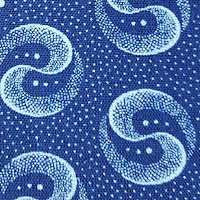 | ||
| Figure 8- French Connection. (2007). Windmills. [ONLINE] |

Monday, 27 May 2019
The Name Isishweshwe
According to Pheto-Moeti (2017: 26) Isishweshwe/ Blue Cloth came to South Africa known as the German Print which was imported from Europe to meet the demand of the German settler women, hence the name German Print appeared. The fabric was then introduced to South Africa by the German settlers, where the name seshoeshoe appeared.
The name appears to have emerged in Lesotho by the early 20 century, associated both with the name and deeds of Lesotho's founder, Moshoeshoe 1 in figure 1. SeShoeshoe later become more widely known throughout South Africa as Isishweshwe(an isiZulu phonetic variant).
 |
| Figure 1- Natal Archives (2011). King of Lesotho- Moshoeshoe 1 [ONLINE] |
Friday, 24 May 2019
The Important Characteristic of Isishweshwe
Pheto-Moeti(2017: 25) stated that since the 1950s African women saw a need to have a national identity and embrace the blue "German Print" or Terantala as it was called, it has evolved extensively. The blue cloth has been passed down to different cultures and I as a black Zulu young woman I use the blue cloth because it relates to my own cultural identity.
According to Leeb-du Toit (2017: 7) it has become clear that isishweshwe was not merely a marker of identity among South African women and men, black and white, but was also esteemed in other areas of southern Africa- in Namibia and Botswana, Lesotho and Swaziland and (earlier) in Zimbabwe and Angola. Informants in some of these regions generously supplied her with information on the importance of isishweshwe as a marker of cultural identity and respect with regards to age grade, marriage and even funerary customs and ceremonies. They clarified the cloths significance for gender and female beauty, in particular , as well as childbearing, propriety and morality and its appropriateness in ukuhlonipha or conventions of respect (ibid).
According to Leeb-du Toit (2017: 7) it has become clear that isishweshwe was not merely a marker of identity among South African women and men, black and white, but was also esteemed in other areas of southern Africa- in Namibia and Botswana, Lesotho and Swaziland and (earlier) in Zimbabwe and Angola. Informants in some of these regions generously supplied her with information on the importance of isishweshwe as a marker of cultural identity and respect with regards to age grade, marriage and even funerary customs and ceremonies. They clarified the cloths significance for gender and female beauty, in particular , as well as childbearing, propriety and morality and its appropriateness in ukuhlonipha or conventions of respect (ibid).
Action Research
My Plan
My plan is to do research based on African fabrics, how they are used in a form of African art, jewellery and fashion. I will be looking at different African wax prints and isishweshwe fabric. Defining my terminology based on isishweshwe and focusing on different aspects of isishweshwe fabric trying to make my work more significant and meaningful by using something that relates to my own cultural identity.
My plan is to do research based on African fabrics, how they are used in a form of African art, jewellery and fashion. I will be looking at different African wax prints and isishweshwe fabric. Defining my terminology based on isishweshwe and focusing on different aspects of isishweshwe fabric trying to make my work more significant and meaningful by using something that relates to my own cultural identity.
My aim is to create jewellery that incorporate patterns, colours, motifs and texture from isishweshwe fabric.What I mean by that is I will be taking patterns from the fabric into metal, find different ways to add colour and texture in my jewellery. I will find relevant references who uses fabric as inspiration and who uses punching, chasing and repousse techniques in there jewellery.
I will then discuss the link between my work and the relevant references. I will observe and reflect on my work by looking at how I have incorporated all visual aspects of the fabric into metal by using the techniques and design principles, find a better way to approach the plan again by doing more test pieces and exploring different ways to improve or enhance patterns, colours and texture from isishweshwe fabric.
Monday, 6 May 2019
Functions of Jewellery
As a part-time and a full-time teacher, Metcalf (1998) wonders where the boundaries of jewellery lie, and what aesthetic potential the field offers because perceptive writing on jewellery is scarce. The theory of painting and sculpture offers very little value because it is always based one agenda of the traditional “fine arts” and they don’t focus more on Jewellery. But he has come to a belief that Jewellery is characterized by social and psychological utility, with the ability to touch people.
Jewellery can be regarded as a body of objects but yet again the definition of the term ‘’jewellery’’ is a bit of a futile exercise. But he has managed to investigate the vast production of historical jewellery and his focal point were the adornment employed in preliterate cultures and examining contemporary western jewellery objects. Then a list of qualities and functions that together define the word was compiled.
Jewellery can be regarded as a body of objects but yet again the definition of the term ‘’jewellery’’ is a bit of a futile exercise. But he has managed to investigate the vast production of historical jewellery and his focal point were the adornment employed in preliterate cultures and examining contemporary western jewellery objects. Then a list of qualities and functions that together define the word was compiled.
Metcalf thinks that jewellery falls between sculpture on one side and garments on the other. I think by saying that he clearly indicate that jewellery can be made to be viewed isolated from the human body like a sculpture. Most jewellery is made to be worn or imagined being worn. Jewellery can be made to complete a certain look, be an everyday wear and a statement piece. And I think when he mention garments he thought of how jewellery helps to complete a certain look only because jewellery is not an ornament that can keep you warm and dry, that’s why he says the line between garments and jewellery is unclear.
Traditionally, jewellery is made to be attached to the body or to clothing. But on the body some varieties demand alteration of the body itself, as in you need your ears pierced in order to wear earrings and for the nose ornaments same thing applies.
Jewellery has always been used to decorate human figure and the word decorate has all kinds of evil idea but it is used without any negative overtones. Then the definition goes back to the characterization of psychology utility and the word decorate satisfies psychological purposes.
Jewellery has always been used to decorate human figure and the word decorate has all kinds of evil idea but it is used without any negative overtones. Then the definition goes back to the characterization of psychology utility and the word decorate satisfies psychological purposes.
Decoration can be defined in many ways, but most decoration is an orchestrated collection of signs with particular meanings and overtones. It create a complex statement of social fact and personal fantasy of which some people might have a different understanding or interpretation. By saying that has come to the subtext of jewellery being marked as a social identity and status.
Social identity and Status means that you can be easily identified by what kind of jewellery you wearing which is the coded information that societies evolve for jewellery that can be employed to the wearer different from his neighbours.
Another traditional function of Jewellery is portable and redeemable wealth where jewellery is utilized as a life insurance policy and also wealth being kept attached on the body for personal needs. It is also associated with Spiritual Mediation where symbols can be worn as a protection ornament or as a constant reminder of one’s faith.
Each of these function partly defines jewellery and some ornaments work hand in hand to outline the five functions that traditionally define jewellery.
Wednesday, 10 April 2019
definition of Isishweshwe

Wednesday, 27 March 2019
Function Of Jewellery
Portable Wealth
Another traditional function of jewellery is to serve as a redeemable investment and a portable wealth. In some cultures they would keep their wealth attached to the body. Woman all over the world wear a substantial portion of their wealth in jewellery, which can be converted into goods and services should be need arise that is according to Metcalf.
When you designing jewellery you need to make sure that it last longer, doesn't easily break or slip off easily. When I was making these platinum earrings I made sure that my Shepard hooks flow with the design as much as it flow with keeping your wealth safe. I thought these earrings fit well with this function cause platinum is very expensive and you need to design something that is safe and secured.
When you designing jewellery you need to make sure that it last longer, doesn't easily break or slip off easily. When I was making these platinum earrings I made sure that my Shepard hooks flow with the design as much as it flow with keeping your wealth safe. I thought these earrings fit well with this function cause platinum is very expensive and you need to design something that is safe and secured.
 |
| Platinum Twirling Earrings |
Function Of Jewellery
Spiritual Mediation
According to Metcalf jewellery has been associated with the spiritual and the supernatural.The intimate contact between symbols and skin as jewellery is worn becomes a constant reminder of ones faith, and the promise of security and salvation.
 |
| Coloured Disks melted beads |
 |
| Enamelled Pendant |
Blue- for emotional healing, inner peace and meditation
I feel like these two pictures are a good example of the above explanation and circle have been working very well with my designs as well as the patterns taken from isishweshwe. My jewellery pieces are not only a reminder of ones faith but also it symbolizes unity, that you can take different aspects from different fields and put them together to create beautiful and meaningful jewellery.
Social Identity
According to Metcalf adornment has always been used to either distinguish or merge the wearer with social grouping. The power of jewellery is to enhance self-image and also to put a title for yourself. Jewellery beautifies, within the value system of the local culture, and sometimes renders the wearer socially or sexually desirable.
 |
| Figure 1- Nkabinde, M. (2018). Punched Disks Earrings. |
Jewellery can build or break your image and what I mean by that is it can build a certain image to people around you which may lead to negative and positive connotation. The jewellery that you wear can state the kind of group you belong whether it is cultural or socially. My jewellery is mainly designed for females but it doesn't necessarily accommodate everyone taste or favourite. Simplicity and minimalism are my design principals I tend to focus on patterns with its meanings, patterns creating images and a hint of colour in my jewellery. On the picture below it is a pair of earrings inspired by isishweshwe, where I've taken patterns from isishweshwe to metal by using punching and drilling techniques. I think it relates to this Metcalf functions of jewellery because of the history behind my inspiration that only certain people know about and understands. Isishweshwe is a traditional fabric used for clothing and I've used that fabric to manufacture my jewellery taking patterns from it. People who are familiar with this fabric can easily identify that you belong to their cultural or traditional group hence i feel like my jewellery does belong to this function.
Wednesday, 5 September 2018
Interesting Patterns and Colour Arrangement
In the last meeting we had,we spoke about the skeleton of our chapter 1 and I have decided to focus more on:
*Patterns
*Colours
*The actual shweshwe fabric
When i looked through my wardrobe this morning i saw this t shirt I've had for years and i started noticing all these different patterns and colours it has. What is more interesting is that these colours complement each other and the patterns creates a beautiful look on the eye. Then I thought of the shweshwe patterns that I'm focusing on. Patterns can be found everywhere and anywhere its just a matter of paying attention to detail and what pleases the eye.


Subscribe to:
Posts (Atom)