Wednesday, 7 August 2019

Isishweshwe Fabric Display


Today I visited a fabric shop. I was looking for fabric I could use for the dress I want to get for a wedding. I came across these beautiful Isishweshwe fabric, with intricate patterns and calm colours. Then I thought to myself it would be a good idea to have all these shades of colours and patterns for my end of year display, not necessarily on my jewellery but maybe on a piece of artwork like Katanu Kay Sanna


Ankara Fabric Display


Monday, 22 July 2019

My Weekend Special

Modern Tradition


my weekend looked something like this, we had a traditional ceremony at home where we all had to put on "isiphandla". we had a ceremony called ukungenisa idlozi, which is when we slaughter a goat for the ancestors, welcoming them into our new house\home.

Tuesday, 2 July 2019

Ankara Fabric

The first picture I took from Tapestry accessories(Instagram) and the second one from Ayokadeco(Instagram) when I looked at them I felt like the bottom one was used as an inspiration to design and manufacture the pair of earrings. I feel like this is a good example of what my whole b-tech is about, using shapes and patterns from isishweshwe fabric to make contemporary jewellery.

Fluted bangle

This bangle reminds me of my Anglo plat design. I like how they have used the concept of curves, bending the strip of metal to create this interesting piece. I don't know if they have used one strip or its different pieces put together but it does indeed look like its done with one strip of metal with one solder joint.

Friday, 14 June 2019

African Blossom

What I find interesting about this picture is the contrast in colours, I really like how the have played with geometric and organic patterns. which reminds me of the whole exploration I'm busy with that includes punching circles and finishing it with the fluted shape on the outside.

Thursday, 13 June 2019

The Purple Headwrap

Headwraps are a sign of respect in a married woman. I think I can use the concept of the overall shapes you get from different fabrics used as headwraps. 

Friday, 7 June 2019

Ankara Fabric

This is an African wax print fabric, its a beautiful traditional African design with vibrant colours.
This fabric is known as Ankara.
I really like how the colour combination works and the patterns complimenting each other.

Process of the Painting

Wednesday, 5 June 2019

Realistic Oil Portrait

Realistic Oil Portrait
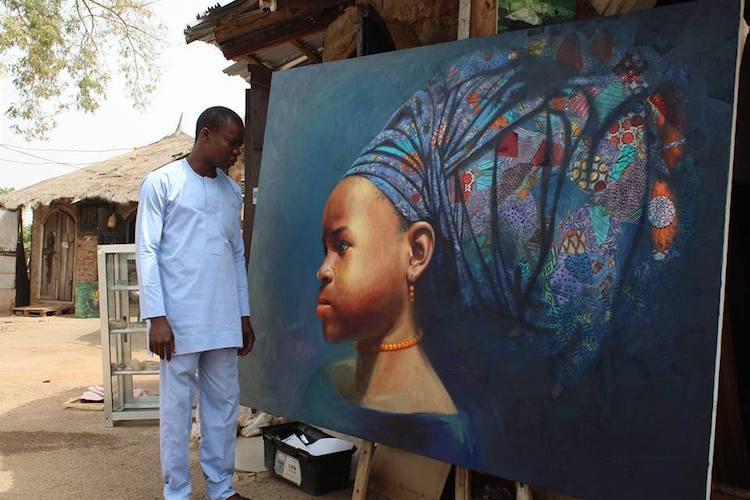
This is a realist oil portrait that I found on Instagram by Clement a Nigeria artist.
He often uses pieces of fabric in his paintings, resulting in a stunning mixed media artwork. Colourful and intricate Nigerian headwraps are a big feature in his work. I like how he gives life and movement to the folds of fabric, his paintings have that African feel and I like how he makes the traditional fabrics the main focus in his paintings.

“Whatever you feed yourself with is what you become” or “If you hide sickness, sickness will hide you in the grave”

Monday, 3 June 2019

Isidwaba

Isidwaba is a traditional Zulu leather skirt worn by a betrothed and married woman. It is made of cow skin or goatskin. It reminds me of my Platinum piece the curly and folded shaped on the edges.

Friday, 31 May 2019

Khosi Nkosi

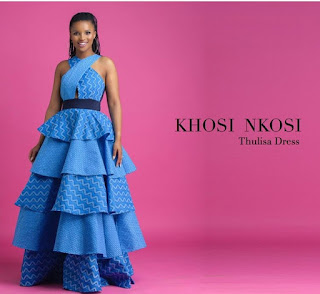
"Khosi Nkosi is a fashion brand established in 2008 by a designer named Nobukhosi Nkosi. The brand name is derived from the Zulu word for royalty and features chic ruffled dresses in traditional African print. The garments are a perfect fusion of traditional and modern taste. She plays around with African prints creating garments that incredible fits on the wearer. Nkosi's collection is perfect for every occasion like wedding, birthdays and office parties, see figure 1"(Hume. n.d)


Figure 1- Nkosi, N. Stretch Shweshwe. [ONLINE]
"The Khosi Nkosi garments are inspired by what the brand essence for: Strong. Modern, Worldly, Nubile woman that loves and respects herself and pays attention to detail"(Nkosi. n.d).
I think her aim is to make garments that are appropriate for every woman with different fashion taste.
I have noticed a style that she uses in most of her garments which is the different layers she create in a dress giving different dimensions, symmetrical and asymmetrical look, see figure 1 &2. I have been working with different layers and folding in my jewellery inspiration drawn from Nkosi's garments.

Thulani Dress
Figure 2- Nkosi, N. Thulisa Dress. [ONLINE]


Monday, 27 May 2019

The Name Isishweshwe

According to Pheto-Moeti (2017: 26)  Isishweshwe/ Blue Cloth came to South Africa known as the German Print which was imported from Europe to meet the demand of the German settler women, hence the name German Print appeared. The fabric was then introduced to South Africa by the German settlers, where the name seshoeshoe appeared.
The name appears to have emerged in Lesotho by the early 20 century, associated both with the name and deeds of Lesotho's founder, Moshoeshoe 1 in figure 1. SeShoeshoe later become more widely known throughout South Africa as Isishweshwe(an isiZulu phonetic variant).

 Figure 1- Natal Archives (2011). King of Lesotho- Moshoeshoe 1 [ONLINE]

Friday, 24 May 2019

The Important Characteristic of Isishweshwe

Pheto-Moeti(2017: 25) stated that since the 1950s African women saw a need to have a national identity and embrace the blue "German Print" or Terantala as it was called, it has evolved extensively. The blue cloth has been passed down to different cultures and I as a black Zulu young woman I use the blue cloth because it relates to my own cultural identity.
According to Leeb-du Toit (2017: 7) it has become clear that isishweshwe was not merely a marker of identity among South African women and men, black and white, but was also esteemed in other areas of southern Africa- in Namibia and Botswana, Lesotho and Swaziland and (earlier) in Zimbabwe and Angola. Informants in some of these regions generously supplied her with information on the importance of isishweshwe as a marker of cultural identity and respect with regards to age grade, marriage and even funerary customs and ceremonies. They clarified the cloths significance for gender and female beauty, in particular , as well as childbearing, propriety and morality and its appropriateness in ukuhlonipha or conventions of respect (ibid).

Action Research

My Plan
My plan is to do research based on African fabrics, how they are used in a form of African art, jewellery and fashion. I will be looking at different African wax prints and isishweshwe fabric. Defining my terminology based on isishweshwe and focusing on different aspects of isishweshwe fabric trying to make my work more significant and  meaningful by using something that relates to my own cultural identity.

My aim is to create jewellery that incorporate patterns, colours, motifs  and texture from isishweshwe fabric.What I mean by that is I will be taking patterns from the fabric into metal, find different ways to add colour and texture in my jewellery. I will find relevant references who uses fabric as inspiration and who uses punching, chasing and repousse techniques in there jewellery.
I will then discuss the link between my work and the relevant references. I will  observe and reflect on my work by looking at how I have incorporated all visual aspects of the fabric into metal by using the techniques and design principles, find a better way to approach the plan again by doing more test pieces and exploring different ways to improve or enhance patterns, colours and texture from isishweshwe fabric. 

Wednesday, 22 May 2019

Clement Mmaduako Nwafor


Clement Mmaduako is an award winning contemporary Nigerian artist and the creative art director of Clemspeter Art Creation Limited. Stewart (2018: para 1 line 1) states that he creates realistic oil portraits incorporating colourful traditional fabric. Clement works with oil paints and collage to create stunning, large-scale paintings on canvas, see Figure 1. His work mainly focuses on portraiture.

Figure 1- Nwafor, C. N. (2018). Large-scale painting on canvas. [ONLINE]
Clement uses Nigerian headwraps (gele) as a big feature in his work, he uses different pieces of fabric, resulting a stunning mixed media artwork, see figure 2. I like the realistic look of the fabric in his painting and how he has uses the contrast of colours which draws a link between his work and mine. I want to capture the importance of the traditional fabric by using the elements of the headwraps from his paintings. 

Figure 2- Nwafor, C. M. (2018). The Gele. Oil painting on canvas. [ONLINE]
Woman wear head-wraps for different occasions whether its for religious, cultural reasons and even as a fashion statement but traditionally in my culture headwraps are usually worn by married women. I admire his work so much because through his artwork he speaks highly of social identity and how woman can be celebrated through art. A head-wrap is a significance of respect and to me respect\ Ukuhlonipha ukuzazi ubuwena futhi ukuziqhenya ngemvelaphi yakho.


Friday, 17 May 2019

Platinum Prototype in silver


Figure 2- Nkabinde, M.,(2019).  Silver.
Figure 1- Nkabinde, M., (2019). Fabric. 

Figure 1 is an example of the fabric motif I used called CDs, from there I manipulated the motif in a simplest way that will have nice pattern to work with see figure 2&3.

        
          Figure 3- Nkabinde, M., (2019). Silver.

                      
                             Figure 4- Nkabinde, M., (2019). Silver.
Once the pattern is punched out then the metal folding part is done see figure 4&5, making sure you anneal in between to get nice curves.
Figure 5- Nkabinde, M., (2019). Silver.

Thursday, 16 May 2019

My part time job

These beautiful rings are a symbol of when i'm not at campus i am somewhere out there making jewellery and making a living for myself. It has been a rough journey having to jungle around work and tech but I've managed just fine cause i can relate both work and tech together. its also a good thing to get the industry exposure cause now i know what is required out there... all thanks to Christy-Anne Jewellery.

Wednesday, 15 May 2019

Copper Disks with Different Pattern Imprints


Figure 1- Nkabinde, M., (2019). Copper and glass beads.

Figure 2- Nkabinde, M., (2019). Copper and glass beads.

Katanu Kay Sanna

Mbaya (2017: para. 2 line 1) states that Katanu Kay is a 19 year old Kenyan artist who uses traditional African fabric in her artwork. She create sculptural pieces that utilize fabric- African fabric at that, to convey colour, movement and emotions.

She started using kitenge fabric in her work when she was doing her art assignment. Where they were given a scenario to design a wall hangings for the lobby at a lodge in Masai Mara. So, she thought 'lions are animals often associated with African culture and so are kitenge fabrics', see figure 1. She merged the two and loved the outcome then she moved to mixing kitenge fabric with other paintings.(Orubo, D. 2017: 2)

Figure 1- Sanna, K. (2017). The Original Lion. Painting with Kitenge Fabric. [ONLINE]

I really like how she completes her painting with the touch of traditional fabric. This has come to a point where I have noticed that she uses the significant of this African fabric to form part of a cultural identity. A link can be drawn between her work and mine through the embracing and modernizing of traditional fabrics that resembles home as in 'Africa'. The actual fabric has been used in her artwork and I wanted to show that it is not only used in clothing but they are different ways to portray the message within the fabric. That is similar to what I want with my jewellery.


Friday, 10 May 2019

Platinum design exploration


These are patterns I've been working with lately, I've decided to work with copper to see if i get the same results as silver and it turned out beautiful with the patterns but i feel like the colours don't pop out nicely in copper. so now i know which metal works beautiful with my melted beads

Monday, 6 May 2019

Functions of Jewellery

As a part-time and a full-time teacher, Metcalf (1998) wonders where the boundaries of jewellery lie, and what aesthetic potential the field offers because perceptive writing on jewellery is scarce. The theory of painting and sculpture offers very little value because it is always based one agenda of the traditional “fine arts” and they don’t focus more on Jewellery. But he has come to a belief that Jewellery is characterized by social and psychological utility, with the ability to touch people.
Jewellery can be regarded as a body of objects but yet again the definition of the term ‘’jewellery’’ is a bit of a futile exercise. But he has managed to investigate the vast production of historical jewellery and his focal point were the adornment employed in preliterate cultures and examining contemporary western jewellery objects. Then a list of qualities and functions that together define the word was compiled.

Metcalf thinks that jewellery falls between sculpture on one side and garments on the other. I think by saying that he clearly indicate that jewellery can be made to be viewed isolated from the human body like a sculpture. Most jewellery is made to be worn or imagined being worn. Jewellery can be made to complete a certain look, be an everyday wear and a statement piece. And I think when he mention garments he thought of how jewellery helps to complete a certain look only because jewellery is not an ornament that can keep you warm and dry, that’s why he says the line between garments and jewellery is unclear.

Traditionally, jewellery is made to be attached to the body or to clothing. But on the body some varieties demand alteration of the body itself, as in you need your ears pierced in order to wear earrings and for the nose ornaments same thing applies.

Jewellery has always been used to decorate human figure and the word decorate has all kinds of evil idea but it is used without any negative overtones. Then the definition goes back to the characterization of psychology utility and the word decorate satisfies psychological purposes.

Decoration can be defined in many ways, but most decoration is an orchestrated collection of signs with particular meanings and overtones. It create a complex statement of social fact and personal fantasy of which some people might have a different understanding or interpretation. By saying that has come to the subtext of jewellery being marked as a social identity and status.

Social identity and Status means that you can be easily identified by what kind of jewellery you wearing which is the coded information that societies evolve for jewellery that can be employed to the wearer different from his neighbours.

Another traditional function of Jewellery is portable and redeemable wealth where jewellery is utilized as a life insurance policy and also wealth being kept attached on the body for personal needs. It is also associated with Spiritual Mediation where symbols can be worn as a protection ornament or as a constant reminder of one’s faith.

Each of these function partly defines jewellery and some ornaments work hand in hand to outline the five functions that traditionally define jewellery.

Monday, 15 April 2019

Ann Cole Jewellery


Taryn Coleman is the founder of Ann Cole Jewellery based in Durban.

According to Coleman (n.d), her jewellery is an expression of love for the serenity of the natural world. From the ocean to the earth and even the stars, I seek to capture and mimic the poetry of natural creations using precious metals and specialised handcrafted jewellery techniques. With a transcendental perspective, my design explores the seemingly supernatural patterns and formations found in nature.

Coleman uses punches fabricated and shaped by hand to create some of her jewellery, see Figure 1 showing the basic tools she uses for her imprints. In 2009 she did her B-tech, that is when she discovered the imprinting technique that she uses in some of her jewellery.

Figure 1- Ann Cole Jewellery. 2019. Imprinting Tools [ONLINE].
In figure 2 is an example of her work done during her b-tech days, it is a good example of what I am aiming to get at the end of my b-tech. I can pinpoint lots of similarities between her work and mine, from the imprinting\ punching technique to the inspiration drawn from Isishweshwe fabric patterns, see figure 3 where she create platinum earrings inspired by Isishweshwe. I have noticed that not all of her jewellery pieces were inspired by Isishweshwe but I like how she takes pattern from her surroundings and make them her own through the imprinting and allowing the metal to speak for itself. 

Figure 2- Ann Cole Jewellery. (2018). Wabi-Sabi. Copper cuff [ONLINE].

Figure 3- Ann Cole Jewellery. (2017). Isishweshwe inspired Platinum earring [ONLINE].

Wednesday, 10 April 2019

mixed materials jewellery


Patterns and colours

Patterns and colours

variate of patterns and colours


circular patterns
pattern is an arrangement of lines or shapes or a design in which the same shape is repeated at regular intervals over a surface.The fabric can be identified by the feel, taste, smell and sound. It is produced in various colours including the original indigo, red and brown and with variety of shapes including diamonds, squares, stripes, floral and circular geometric patterns. These are examples of all the patterns and colours you get from Isishwshwe but i have a special interest of patterns that i am focusing on. I'm looking at all the circular patterns,the ones that are created by different patterns to make one circular one or circular patterns on their own.


definition of Isishweshwe


its the definition of isishweshwe and the indigofera plant where the colours indigo was first obtained from.

splash page


Thursday, 28 March 2019

Emma Smith

According to Emilia Sarupdeo "For me working with sculptural forms has given me the freedom to Express myself"
Since I've been working with patterns I have realized that everything around me evolves around patterns. It might not be perfect squares or circle. Repetition of lines and arrangements of things around you they form certain patterns on they own.
This sculpture has drawn my attention because when I looked at it the beauty behind it lays on the different patterns overlapping and intersecting each other and how he has used the different sizes and shapes.

Wednesday, 27 March 2019

Function Of Jewellery

Portable Wealth

Another traditional function of jewellery is to serve as a redeemable investment and a portable wealth. In some cultures they would keep their wealth attached to the body. Woman all over the world wear a substantial portion of their wealth in jewellery, which can be converted into goods and services should be need arise that is according to Metcalf.
When you designing jewellery you need to make sure that it last longer, doesn't easily break or slip off easily. When I was making these platinum earrings I made sure that my Shepard hooks flow with the design as much as it flow with keeping your wealth safe. I thought these earrings fit well with this function cause platinum is very expensive and you need to design something that is safe and secured.
Platinum Twirling Earrings


I saw this beautiful painting with different patterns- On Station Drive
patterns can be found every where you go...